
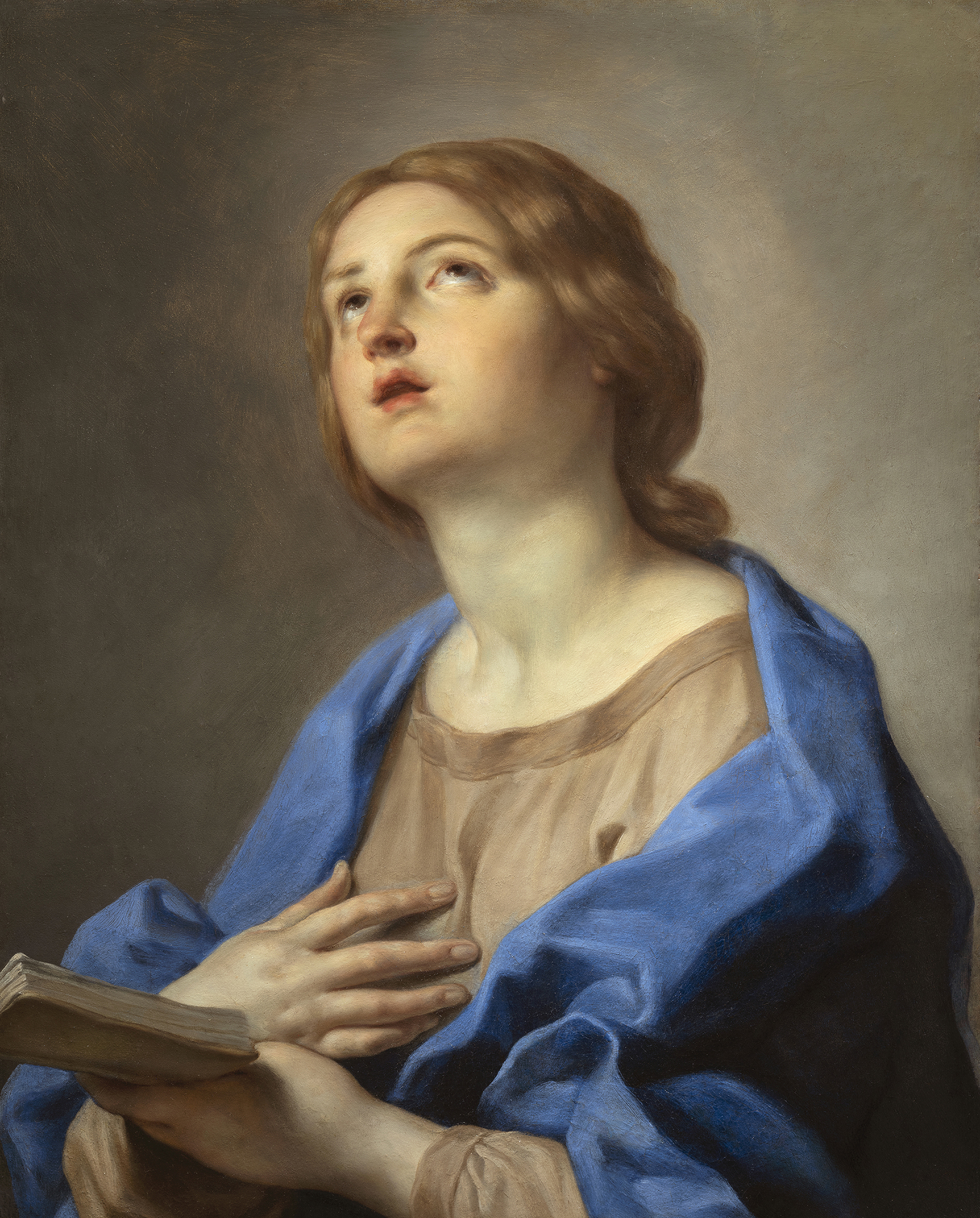
Carlo Cignani
Bologna, 1628 – Forlì, 1719
The Virgin in Prayer, c. 1680
Oil on copper, cm 68 x 55
"Incontro con la pittura 33"
Press release
On Saturday, November 7, the thirty-third edition of “Incontro con la Pittura”organized by Fondantico Art Gallery, opens in the prestigious setting of Casa Pepoli Bentivoglio, in the heart of Bologna (Via de’ Pepoli 6/E). Entitled A Journey through Painting, the exhibition presents around forty works, including paintings and drawings, spanning from the early decades of the fifteenth century to the end of the nineteenth century.
The exhibition opens with a panel depicting Saint Sebastian, attributed to the late-Gothic master who decorated the Palazzo Pendaglia in Ferrara during the early decades of the fifteenth century. It is followed by Saint Francis of Assisi and Saint Sebastian by the Venetian painter Bartolomeo Vivarini, who, together with his elder brother Antonio, created the celebrated polyptych commissioned by Pope Nicholas V in 1450 for the altar of the Certosa church in Bologna, now housed in the National Gallery of Bologna.
Remaining faithful to the classicism of their father Francesco Francia, one of the key figures who guided Italian painting toward the Maniera Moderna, his sons Giacomo and Giulio are represented by a panel of the Annunciation. Bartolomeo Passerotti, meanwhile, in his Portrait of a Condottiere painted around 1575, displays an original synthesis of naturalistic observation and rhetorical animation, highlighting his contribution to the renewal of Bolognese painting during the second half of the sixteenth century.
Moving into the seventeenth century, visitors encounter a luminous copper painting of the Virgin in Meditation by Carlo Cignani, champion of Bolognese classicism and lifelong Prince of the Clementine Academy; an oval depicting Ceres and Bacchus, also interpretable as an Allegory of the Earth, painted in 1685 for the Monti family by Marcantonio Franceschini, Cignani’s most gifted pupil; and a large canvas, probably intended for the grand hall of a Venetian palace, portraying a servant engaged in plucking poultry and arranging baskets of flowers, who seems to turn toward the viewer asking what they desire, thus evoking the spirit of hospitality in a country villa.
In the field of early eighteenth-century portraiture, Donato Creti presents a work of remarkable charm that carries an elusive story, perhaps that of two betrothed lovers. Sacred paintings by Ubaldo and Gaetano Gandolfi, Domenico Pedrini, and Jacopo Alessandro Calvi, the latter represented by an intact series of Mysteries of the Rosary, testify to the artistic taste fostered by the Clementine Academy during the transition from Rococo to Neoclassicism.
An extraordinary interpreter of the Neoclassical age was Felice Giani, represented here by eight sheets drawn on both sides, once contained within a portable sketchbook. These reveal his interest in Francesco Francia, Amico Aspertini, and Ludovico and Annibale Carracci. As private exercises, they provide invaluable insight into the artist’s working methods, offering us a glimpse into his creative daily life.
An equally intimate dimension emerges in the paintings depicting the interiors of the Church of Calvary within the Santo Stefano complex, rendered with exquisite precision by Antonio Basoli, a leading figure in Bologna during the first half of the nineteenth century. Basoli was especially renowned, from the mid-1820s onward, for his views of his beloved city, many of which were translated into prints by his brothers and published in the volume Picturesque Views of the City of Bologna (1833).
The exhibition concludes with a substantial section devoted to Bolognese painting of the second half of the nineteenth century. Landscape painting is represented by Luigi Bertelli, who immortalized the Staubbach Falls in Switzerland during the journey that took him to France in 1867 to study the Barbizon masters, and by Augusto Sezanne, author of the rare 1883 painting Spring Harmonies, executed along the banks of the Rhine.
An example of the genre painting promoted by the celebrated French dealer Adolphe Goupil is Giovanni Paolo Bedini’s panel The Art Lover, which enters into dialogue with Fabio Fabbi’s refined Bohemian Interior. Finally, Mario de Maria’s Salome, formerly in the Chierichetti collection, offers a significant testimony to the decadent fin-de-siècle Symbolist movement.